Tuesday, March 24, 2020

Adventures in applied theology

A Latter-day Saint who writes for the Atlantic reminisces on food stockpiling.  One of my best friends in elementary school was a Latter-day Saint and I remember being quite fascinating by his family's one year (no three month softness for them - perhaps that is an east coast heresy) food supply which they kept in a sort of loft in their garage. It always seemed like a pretty reasonable idea to me.

Monday, March 23, 2020

Assorted links (from a while ago)

1. Academic confessions on twitter.

2. My old friend David Ramsey Steele on George Orwell and Alex Comfort by way of a book review.

3. Looking for a chateau that looks like all the other chateaus?

4. Abandoned Six Flags park in New Orleans

5. Charlie will like this comic.

6. Clearly this faculty member needs more committee assignments.

Quarantine choices


Still sorting out what it means that my (happily married) ex sent this to happily married me.

Sunday, March 22, 2020

Online instruction at UW-Madison

The local paper reports on the progress made at UW-Madison, which switches to online courses only for the remainder of the semester starting tomorrow.

The number of students claiming to not have sufficiently good internet at home to allow for streaming  video strikes me as much too high - probably some selective survey response / non-response going on there (though of course no survey response rate is provided in the article).

The university further complicated things a couple of days ago by pushing faculty pretty firmly to start doing their online teaching from home.

It will be interesting to see the lasting effects of this sudden mass payment of the fixed costs associated with online instruction by both students and faculty. Clearly, some courses in the arts and the hard sciences really do need to be conducted in person if possible. Others, like many chalk-and-talk lecture coureses in economics, really do not need to be done in person.

And of course, once lectures go on line, one starts to wonder why we don't just have a few really good lecturers make the videos rather than having local lecturers of heterogeneous quality make them. Does it really make sense for thousands of faculty with highly variable talents in public speaking to prepare, say, introductory econometrics courses every semester? I suspect that some painful efficiency gains await in the (now nearer) future.

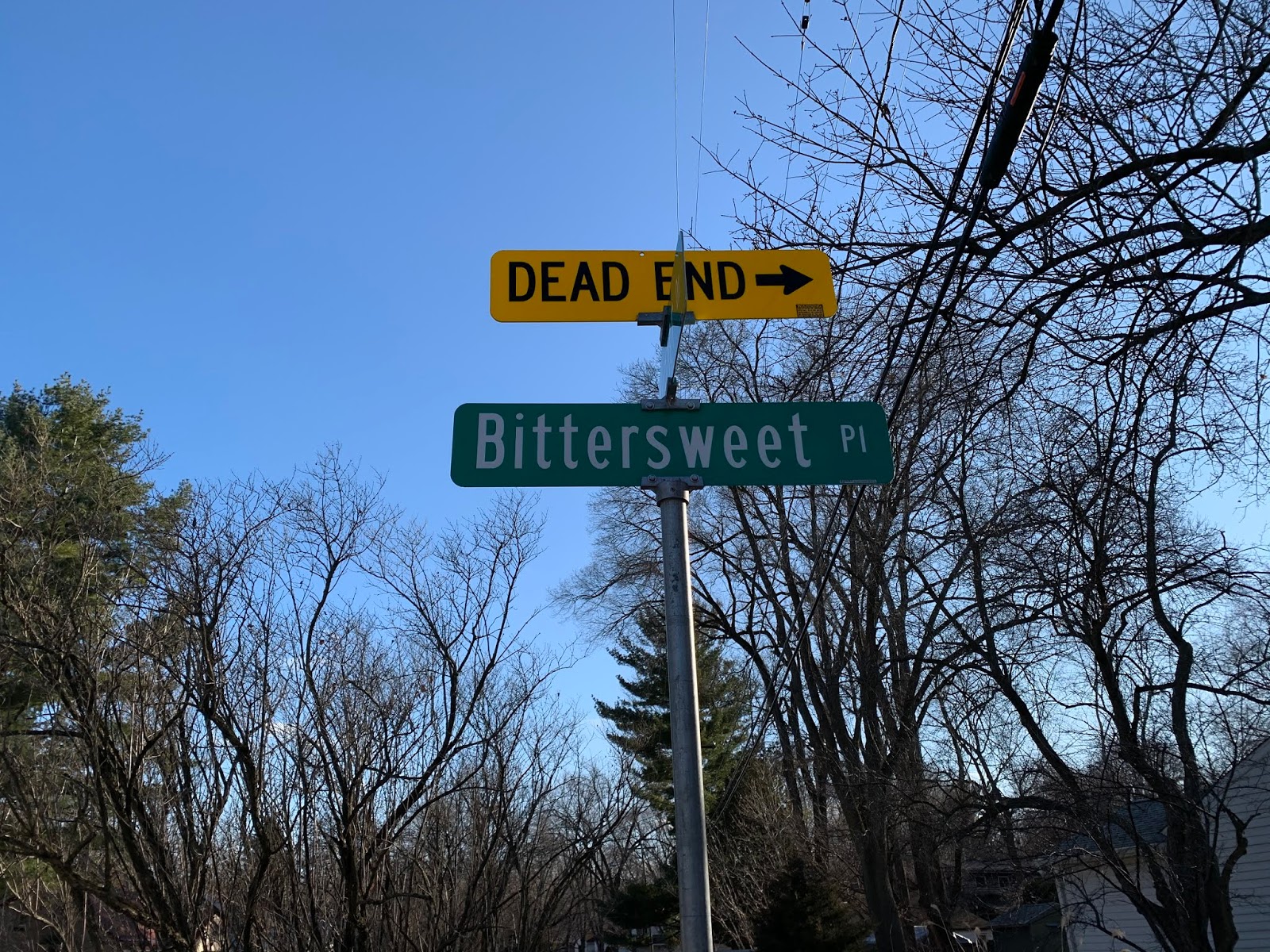
Emotive street signs


Who would have guessed that Bittersweet Place would be a dead end?

From yesterday's socially distant sojourn.

Saturday, March 21, 2020

Book: Against Prediction by Bernard Harcourt

Harcourt, Bernard. 2007. Against Prediction: Profiling, Policing, and Punishing in an Actuarial Age. Chicago: University of Chicago Press

This is really two books in one. The first part of the book is a completely fascinating history of the use of prediction (a.k.a. statistical treatment rules, a.k.a. profiling) in a criminal justice context in the United States. Perhaps surprisingly, this history dates back to eccentric sociologists in the early 20th century. The history has interest in its own right, but also serves as yet one more reminder that using statistical models applied to what were at the time "big" data to generate actionable predictions is no new thing. The methods have improved, and our standards of bigness have grown, but the idea and an understanding of many of the basic issues go way back.

The second half of the book critiques the more recent literature and policy practice in the criminal justice domain. This critique has three parts: The first makes the point that individuals most likely to engage in some behavior may not be those most likely to respond to some intervention. This is not a new point - it appears in Black, Smith, Berger and Noel (2003) in the context of UI profiling and it was not new there either - but it is one that many people really have trouble understanding. Much of this discussion in the book centers on the literature on police profiling in roadside stops. The second criticism concerns a sort of "ratchet" effect whereby the focus of criminal justice resources on one particular group as a result of the use of prediction models leads to a misguided change in public perceptions of underlying differences in criminal behavior across groups. The third criticism concerns changes in our underlying philosophical notions of justice that might result from the growing dominance of prediction in how we implement the justice system in practice.

I found the first criticism both the best realized in the book and the most compelling. The others are provocative and, in the case of the ratchet effect, have a sort of face validity, but, I felt, a bit underdeveloped in the text.

I enjoyed reading the book and learned a lot from it. Recommended if you are into such things.

Amazon book page
Barnes and Noble book page

Hat tip: Shawn Bushway, for recommending it to me several years ago.

Friday, March 20, 2020

There is no great stagnation - oreo edition


The sad fact of the matter is that it took me a while to figure out these variants were not actually for sale to the general public.

Hat tip: my wife the healthy eater